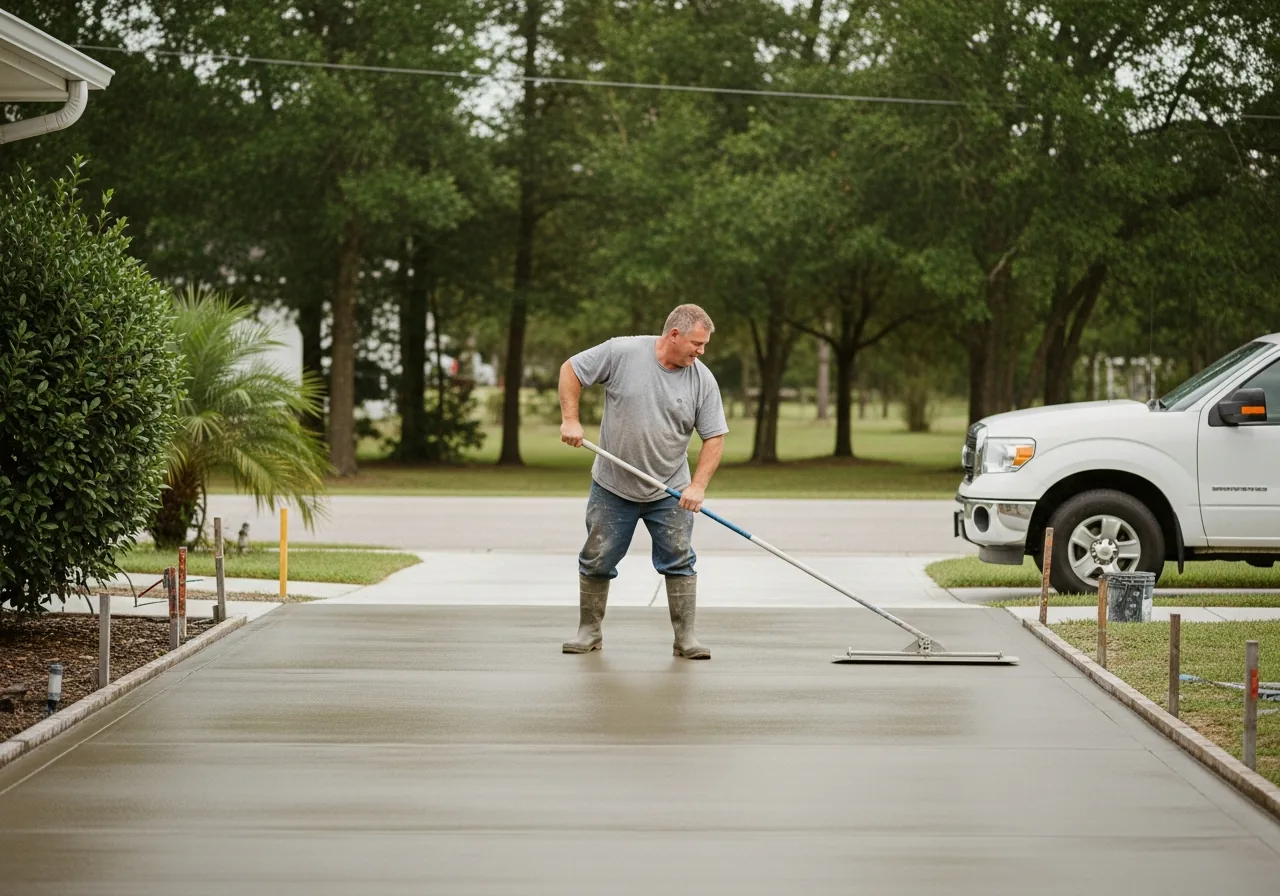
Send a $6,800 driveway quote with sqft and cubic-yard breakdown. Coordinate the form crew and the pour truck and the finishers for a Saturday 6am pour. Track which Phoenix neighborhood pays your premium tier.
$1 for 14 days, then $19/mo. Card required. Cancel any time.
$79/mo vs $99–$299 industry standard·20-min migration from HCP, Jobber, ServiceTitan·No per-seat fees, ever
Features concrete shops actually use
Built for Concrete Contractors
The 5 things that decide whether you nail a Saturday driveway pour or watch the truck wait an extra hour while your forms aren't ready, on-site quotes with sqft and cubic-yard math, crew and concrete truck and finishers dispatch coordination, real margin per pour (cubic yards and rebar and dump fees and slope), photo records of forms and pour and finished slab, and Google Ads ROI on $30-a-click concrete keywords. All in one app. Built by people who've finished a 1,400-sqft Phoenix driveway pour at 7:42am before the temp hit 105°.
On-Site Quotes with Cubic-Yard Math*
Walk the project. Measure (laser or wheel), driveway 24x42 = 1,008 sqft × 4" thick = 12.4 cubic yards. Build the quote in 6 minutes, $6,800 (concrete $1,860 at $150/yd and rebar $385 + forms and labor $2,650 + finishing and sealer and permit + 18% margin). Customer signs digitally and pays a 30% deposit before you back out of the driveway.
Pour Day Dispatch Coordination*
Form crew Friday afternoon (sets forms and rebar). Pour truck Saturday 6am (concrete delivery from Cemex). Finisher crew Saturday 6:15am (3 finishers for the 1,008-sqft pour). Claver coordinates all three to land in the right order. No "where's the pour truck?" at 6:14am with the forms ready and the customer waiting.
Real Margin Per Pour*
Cubic yards, rebar, fiber mesh, forms, labor hours, finishing time, sealer, tracked per job. Your $6,800 driveway shows 41% margin (12.4 yards, 4-hour finish window, no slope issues). Your $11,200 patio and walkway shows 28% because the slope required two reset finishes. Your $4,200 slab-only garage extension shows 22% because the rebar grid was tighter than quoted.
Photo Records Before / Pour / Final*
Pre-job: existing condition and grade and slope readings. Forms set: photo of every form board and rebar grid and thickness tabs. During pour: photo every 15 minutes during the 35-minute pour. Post-finish: completed slab and control joints and sealer. The customer signs off on the photos in her portal, and the warranty claim 24 months later closes in your favor.
Google Ads and Lead Source ROI*
Concrete keywords cost $25-$50 per click. Claver captures the click ID and follows it through quote → signed contract → final payment. "Concrete driveway Phoenix" generated 18 clicks, 11 quotes, 4 signed jobs worth $32,000. "Concrete contractor near me" generated 67 clicks, 1 quote, $4,500 in jobs.
* Included on Crew at $39 a month or Business at $79 a month. Starter ($19/mo) covers unlimited jobs, quotes, invoices, Stripe payments, customer portal, online booking, recurring billing, and CSV export. Step up to Crew for texting, AI, and dispatch.
Why concrete shops switch
Why Concrete Contractors Choose Claver
The 35-Minute Pour Window
Concrete is a same-day operation built around a 35-minute pour window. The forms have to be set Friday afternoon. The truck has to arrive Saturday at 6am. The finishers have to be on-site at 6:15am. If any link in the chain slips, you're either paying the truck driver standby fees or you're finishing at 110° in August, which is a quality problem you'll fix on a callback in March.
The shops that win two things differently: they quote on-site with sqft and cubic-yard math (so the customer sees the price the same day), and they coordinate the form crew and pour truck and finishers to land in the right order (so the Saturday morning pour goes off as scheduled).
The on-site quote is the engine. Pour day coordination is what makes the slab profitable instead of a callback.
When you walk Mrs. Castillo's driveway project in Ahwatukee, the quote builds itself in the app. Measure with laser: 24 feet wide × 42 feet long = 1,008 sqft × 4 inches thick = 12.4 cubic yards of concrete. Photograph the existing condition (cracked 1985 driveway, moderate spalling, 2-inch settlement at the apron). Measure slope (1.5% pitch from garage to street, acceptable for drainage). Build the quote: $6,800 (concrete delivery 12.4 yards × $150/yd = $1,860 + rebar $385 + form materials + 2-day labor $2,650 + finishing crew and Cemex sealer and permit and dump fees on the demo + 18% margin). Customer signs digitally, pays a $2,040 deposit. Form crew set Friday afternoon. Pour Saturday at 6am.
Pour Day Coordination
Pour day coordination is where most concrete shops eat their margin in standby fees and finish quality. Friday 2pm: 3-person form crew sets the perimeter forms, places the rebar grid (#4 bars on 12" centers), checks the slope with a laser level, places the thickness tabs. Friday 5pm: form crew leaves with the project ready for Saturday's pour. Saturday 5:45am: 3-person finisher crew arrives, sets up the trowels and bull float. Saturday 6:00am: Cemex pour truck arrives with 12.4 yards (12.5 yards loaded, leaving 0.1 yard for slosh). Saturday 6:15-6:50am: pour completes, finishers screed and bull-float as the truck pulls away. Saturday 7am-12pm: finisher crew works the slab through bleed, edges, control joints, finish trowel. Claver coordinates all three teams and the truck to land in the right order. No "where's the pour truck?" at 6:14am with the forms ready and the customer in her bathrobe holding coffee.
Photo documentation is what protects you on the Year-2 callback. Claver structures every pour around timestamped photos: pre-job grade and slope readings, forms set with the rebar grid visible, every 15 minutes during the 35-minute pour, completed finish with control joints visible, sealer applied, post-pour cleanup. The customer signs off on the photo timeline in her portal. When she calls back 24 months later about a hairline crack at the control joint, you pull up the photos showing the joint was correctly placed at the 1/3 of the slab depth and the spacing was every 8 feet (within ACI standards for the slab thickness). The warranty conversation is honest from the first sentence, and the hairline crack is not your problem because the documentation proves the install was correct.
Which Scopes Pay
Job costing tells you which scopes pay and which ones bleed. Your $6,800 driveway shows 41% margin (12.4 yards, 4-hour finish, no slope issues). Your $11,200 patio and walkway shows 28% margin because the slope required two reset finishes after the Phoenix wind kicked dust into the bleed water and you had to refloat. Your $4,200 garage slab extension shows 22% because the rebar grid was tighter than quoted (9" centers instead of 12") to satisfy the slope to the floor drain. Now you know which scope to push, which to bump 8% in your next pricing review, and which add-on jobs to refuse politely.
And here's where most concrete shops fly blind: marketing spend. You're paying $25-$50 per click on Google Ads for keywords like "concrete driveway [city]" and "residential concrete contractor." Some clicks become $11,200 patio and walkway jobs. Some become nothing. Claver captures the Google click ID when someone visits your site and tracks it through quote → signed contract → final payment. "Concrete driveway Phoenix" generated 18 clicks, 11 quotes, 4 signed jobs worth $32,000. "Concrete contractor near me" generated 67 clicks, 1 quote, $4,500 in jobs. Triple the first campaign. Cut the second.
Cancel anytime. 20-minute migration from your current tool.
Pricing
Pricing That Works for Concrete Shops
$19/mo to start. $39/mo for growing teams. $79/mo for the full toolkit. AI summaries, app phone line, on-site quoting, pour day dispatch, real-time job costing, photo documentation, Google Ads ROI. Same plans as every Claver page, no concrete upsell.
Simple pricing, no free tier
Every plan includes unlimited jobs, quotes, invoices and Stripe payments. Texting and AI start on Crew. The phone system and full back office are on Business.
$1 for your first 14 days on Starter · Cancel anytime · Your data exports in CSV
Common questions
Common concrete software questions
No marketing dance. The questions concrete owners actually ask before they sign up.
Does Claver build on-site quotes with cubic-yard math?+
Yes. Walk the project, measure with laser, photograph existing conditions and slope. Build the quote in 6 minutes, driveway 24x42 = 1,008 sqft × 4" thick = 12.4 cubic yards = $6,800 (concrete $1,860 at $150/yd and rebar $385 + forms + 2-day labor $2,650 + finishing and sealer and permit + 18% margin). Customer signs digitally and pays a 30% deposit through Stripe before you back out of the driveway.
Does it coordinate form crew and pour truck and finishers for the Saturday pour?+
Yes. Friday 2pm: form crew sets the perimeter forms, rebar grid, slope, thickness tabs. Friday 5pm: form crew leaves with the project ready. Saturday 5:45am: finishers arrive and set up. Saturday 6:00am: Cemex pour truck arrives with 12.4 yards. Saturday 6:15-6:50am: pour completes, finishers screed and bull-float. Claver coordinates all three teams and the truck to land in the right order. No "where's the pour truck?" at 6:14am with the forms ready and the customer in her bathrobe holding coffee.
Can it document the pour for warranty protection?+
Yes. Claver structures every pour around timestamped photos: pre-job grade and slope readings, forms set with the rebar grid visible, every 15 minutes during the 35-minute pour, completed finish with control joints visible, sealer applied, post-pour cleanup. The customer signs off on the photo timeline in her portal. When she calls back 24 months later about a hairline crack, you pull up the photos showing the control joint was correctly placed at 1/3 of slab depth and spacing was every 8 feet, within ACI standards. The warranty conversation is honest from the first sentence.
Can I import customers from Jobber, ServiceTitan, or Housecall Pro?+
Yes. Export your customer list as CSV from your current tool. Jobber, ServiceTitan, Housecall Pro, FieldEdge, and upload it to Claver. The wizard maps the columns. Most concrete shops finish the migration in 20-30 minutes. We'll personally help if anything looks off, email [email protected].
What does Claver cost for a concrete shop?+
$19/mo for Starter (2 users). $39/mo for Crew (8 users) when you want texting, AI, and the dispatch board. $79/mo for Business with the full toolkit, on-site quoting, pour day dispatch coordination, photo documentation, real-time job costing, Google Ads conversion tracking. No contract. Cancel anytime.
Your current software owns your customer list. We don't want to.
Your data exports as CSV the day you leave — your full customer list, every job, every invoice. Your payments go directly through your own Stripe, never ours. Claver starts at $19/mo flat, no contract, no per-seat fees.
Start your $1 trial
14 days for $1, then $19/mo. Cancel any time from settings.