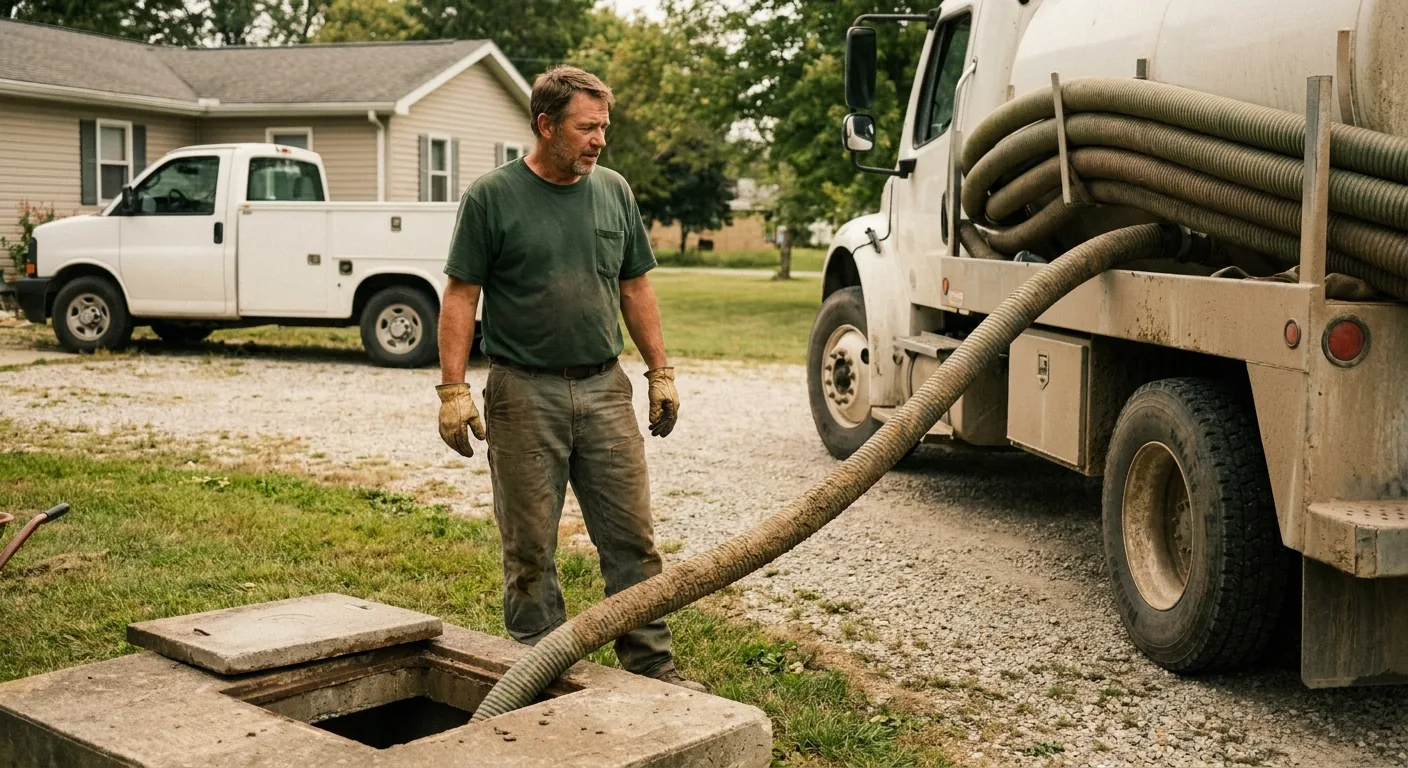
Run a 14-stop pumping route on Tuesday without missing a tank. Send a $385 inspection and pump quote from the customer's driveway. Document every gallons-pumped reading the state board needs.
$1 for 14 days, then $19/mo. Card required. Cancel any time.
$79/mo vs $99–$299 industry standard·20-min migration from HCP, Jobber, ServiceTitan·No per-seat fees, ever
Features septic shops actually use
Built for Septic Service Companies
The 5 things that decide whether you stay on the right side of the state board and the right side of profit are recurring 3-year pumping schedules that auto-renew, route density that fits 14 tanks a Tuesday, on-site state-compliant pumping records (gallons, conditions, hauler manifest), inspection workflow with photos for real-estate transactions, and address notes for tank location and access. All in one app. Built by people who've pumped a 1,500-gallon tank at the back of a 280-foot driveway in rural North Carolina at sunrise.
Auto-Renewing 3-Year Pumping Schedules*
Customer signed up for the recurring 3-year residential pumping plan at $385. Claver puts the next service date on the calendar 36 months out, sends a 60-day reminder text, and auto-bills through Stripe the day of service. Your 800-customer recurring base auto-bills $307,000/year, and renews itself.
Route Density for 14-Stop Tuesdays*
The dispatch board groups tanks by zip code, calculates drive time and dump location proximity, and fits the day. Your Tuesday went from 6 tanks with three trips to the dump to 14 tanks with one trip, same truck, same driver, revenue more than doubled.
State-Compliant Pumping Records*
Every pump logs gallons removed, tank condition (baffles intact, scum/sludge depth, inlet/outlet clear), hauler manifest number, and disposal site. The state inspector shows up Wednesday, you hand them the iPad with 4 years of clean records, and they're gone in 22 minutes.
Inspection Workflow with Photos*
Real-estate transaction inspection: tank size and age, baffles, drain field test, drainage capacity. Photos auto-attach to the inspection PDF the realtor's title company needs. You stop spending 90 minutes assembling the inspection report at 9pm Sunday, it bundles automatically when the tech closes the job.
Tank Location and Access Notes
Tank size (1,000 / 1,250 / 1,500 gallon), location (15 feet behind the deck, marked with white PVC stake), access (driveway holds the truck, gate code 4729, dog Bowie sleeps in the side yard, leave gate open), prior service history. Your tech pulls up the address and knows where the lid is before he leaves the shop.
* Included on Crew at $39 a month or Business at $79 a month. Starter ($19/mo) covers unlimited jobs, quotes, invoices, Stripe payments, customer portal, online booking, recurring billing, and CSV export. Step up to Crew for texting, AI, and dispatch.
Why septic shops switch
Why Septic Service Companies Choose Claver
Recurring Work, State Compliance
Septic is a recurring business with a state-compliance problem. The pumping route is the engine. 800 residential customers on a 3-year cycle is $307,000/year of pure recurring revenue. The state board inspection is the part that can shut you down on a Wednesday morning if your records are in a binder in the truck cab.
The shops that win run two things differently. They auto-renew the 3-year pumping schedule so customers never lapse. Lapsed customers don't call back, they call a competitor. They log every pumping record in a state-compliant format from the field. This makes the inspector visit a 22-minute non-event instead of a 6-hour binder dig.
The recurring schedule is the engine. The compliance log is the survival kit.
When a customer signs up for the recurring 3-year residential pumping plan at $385, Claver structures the relationship for the next 9-12 years. Service date 1 is today. Service date 2 is 36 months out, auto-scheduled. Service date 3 is 72 months. Service date 4 is 108 months. Sixty days before each service, the customer gets an automatic reminder text. It says your 3-year septic pump is due in the month. We will be out on the day. Reply STOP to reschedule. The day of service, your tech arrives, pumps the tank, logs the record, and Stripe pulls the $385. The customer never has to remember anything. You never chase a renewal. Your 800-customer recurring base bills itself.
Route Density on Tuesdays
Route density is what turns 6-stop Tuesdays into 14-stop Tuesdays. Most septic shops without route optimization scatter their pumps across the county. They drive 18 miles, pump, drive 14 miles to the dump, drive 22 miles to the next pump, and dump again. Claver groups tanks by zip code, calculates drive time and proximity to your disposal site, and fits the day. Your Tuesday route now hits 14 tanks in the same county-line corridor with one dump trip after stop 7 and a final dump at end of day. Same truck, same driver, revenue doubled, and you are home by 5pm instead of 7pm.
State-compliant pumping records are what keeps your hauler license clean. Every pump auto-logs gallons removed (1,200 gallons from a 1,500-gallon tank), tank condition (baffles intact, sludge depth 8 inches, scum 4 inches, inlet clear, outlet partially clogged, recommend D-box inspection), hauler manifest number (auto-generated and sequenced), disposal site (City of Raleigh treatment plant, ticket #4729). The state inspector shows up Wednesday morning. You hand them the iPad and pull up four years of clean, time-stamped, geo-tagged records. They are gone in 22 minutes instead of 6 hours of digging through paper logs.
The Inspection Workflow
Inspection workflow is the side hustle that funds your slow weeks. Real-estate transaction inspection includes tank size and age (1,000-gallon, installed 1998), baffles (concrete, both intact), drain field test (200 gallons of water, all absorbed within 18 minutes, passing), and drainage capacity (acceptable for 4-bedroom occupancy). Photos auto-attach (lid removed showing baffles, drain field probe locations, distribution box). The inspection PDF generates automatically when the tech closes the job. It is sent to the customer, the realtor, and the title company. You stop spending 90 minutes assembling the report at 9pm Sunday.
And tank location notes turn the 90-minute discovery visit into a 35-minute pump. The tank is 1,500-gallon, located 15 feet behind the deck (marked with a white PVC stake), has a 4-inch lid (no riser), driveway holds the truck (gravel, slight grade), gate code 4729, dog Bowie sleeps in the side yard, leave gate open after pumping, customer prefers Saturday morning service. When your tech rolls up to the address for the next 3-year pump, he does not dig three test holes looking for the lid. He walks straight to the marked stake, shovels 8 inches of dirt off, and starts pumping. Three more pumps that day.
Cancel anytime. 20-minute migration from your current tool.
Pricing
Pricing That Works for Septic Shops
$19/mo to start. $39/mo for growing teams. $79/mo for the full toolkit. AI summaries, app phone line, recurring billing, route optimization, state-compliant pumping records. Same plans as every Claver page, no septic upsell.
Simple pricing, no free tier
Every plan includes unlimited jobs, quotes, invoices and Stripe payments. Texting and AI start on Crew. The phone system and full back office are on Business.
$1 for your first 14 days on Starter · Cancel anytime · Your data exports in CSV
Common questions
Common septic software questions
No marketing dance. The questions septic owners actually ask before they sign up.
Does Claver auto-renew 3-year recurring pumping schedules?+
Yes. Customer signs up for the recurring 3-year residential pumping plan once. Claver schedules the next service 36 months out, sends a 60-day reminder text, and auto-bills through Stripe the day of service. Your 800-customer recurring base auto-bills $307,000/year and renews itself for 9-12 years. Customers never lapse, and lapsed customers are the ones who don't call back.
Does it log state-compliant pumping records from the field?+
Yes. Every pump auto-logs gallons removed (e.g. 1,200 from a 1,500-gallon tank), tank condition (baffles intact, sludge depth 8 inches, scum 4 inches, inlet clear, outlet status), hauler manifest number (auto-generated and sequenced), disposal site (City of Raleigh treatment plant, ticket #4729). State inspector shows up, you hand them the iPad with 4 years of clean, time-stamped, geo-tagged records. Gone in 22 minutes instead of 6 hours of paper logs.
Does it handle real-estate transaction inspections?+
Yes. Real-estate transaction inspection workflow captures tank size and age, baffles condition, drain field test (gallons and absorption time), drainage capacity rating, photos of the lid and baffles and drain field. The inspection PDF generates automatically when the tech closes the job, sent to the customer, the realtor, and the title company. You stop spending 90 minutes assembling the report at 9pm Sunday.
Can I import customers from ServiceTitan, Jobber, or PestPac?+
Yes. Export your customer list as CSV from your current tool. ServiceTitan, Jobber, ServSuite, PestPac, FieldEdge, and upload it to Claver. The wizard maps the columns. Most septic shops finish the migration in 30-45 minutes (more historical pumping records and inspection data than most trades). We'll personally help if anything looks off, email [email protected].
What does Claver cost for a septic service shop?+
$19/mo for Starter (2 users). $39/mo for Crew (8 users) when you want texting, AI, and the dispatch board. $79/mo for Business with the full toolkit, recurring billing, route optimization, state-compliant pumping records, real-estate inspection workflow, ad-conversion tracking. No contract. Cancel anytime.
Your current software owns your customer list. We don't want to.
Your data exports as CSV the day you leave — your full customer list, every job, every invoice. Your payments go directly through your own Stripe, never ours. Claver starts at $19/mo flat, no contract, no per-seat fees.
Start your $1 trial
14 days for $1, then $19/mo. Cancel any time from settings.